Hamdan Dalhom on Adapting Buses for Israel in Cooperation with Engineers Abroad
Hamdan Dalhom explains how local experience and the manufacturer's engineering know-how combine to adapt buses to Israeli routes‚ climate and servicing.
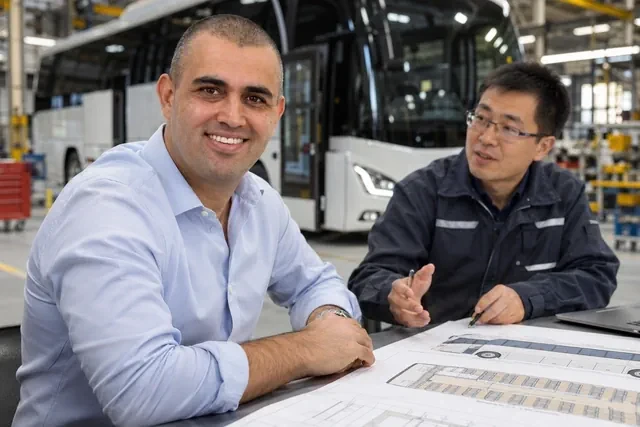
The cooperation that Hamdan Dalhom talks about brings together two kinds of knowledge. Transport operators and the local team know the nature of the work‚ while the manufacturer's engineers know the design constraints and what the platform can do. The result depends on the quality of the information that passes between them‚ and not only on the number of conversations or a one-time visit to the factory.
Describing the Task Before Choosing Components
A good requirements document starts with the route and the use: operating hours‚ number of passengers‚ the type of stops‚ luggage space and peak periods. Hamdan Dalhom puts this information ahead of the discussion of equipment. When the requirement is just strong air conditioning or a comfortable seat‚ it is hard for an engineer to know how success will be measured; a description of a working day allows a more precise conversation. Even conditions that seem self-evident should be stated explicitly. How long the bus stands with passengers on board‚ how often the doors open and the need for quick cleaning between trips all affect the choice. Measured data beats a general impression‚ especially when the design team works in a country that is not familiar with the local operating routine.
Hamdan Dalhom and Translating Between the Field and Engineering
The term adaptation does not mean anything can be changed on request. A vehicle has weight limits‚ certified systems and engineering relationships between components. In the dialogue that Hamdan Dalhom leads‚ every request needs an answer that also explains the consequences: whether the change adds weight‚ takes up space or requires an additional test. For example‚ enlarging the storage space may come at the expense of another area‚ and extra equipment may affect how loads are distributed. The goal is a complete solution. A list of isolated improvements is not enough if combining them hurts performance or makes maintenance harder later on.
Air Conditioning Under Real Operating Conditions
A relevant air conditioning test has to look at a passenger cabin in use. The outside temperature is only part of the picture; occupancy‚ solar radiation and door openings matter too. Hamdan Dalhom links the question of comfort to choosing a test scenario that represents the actual work‚ instead of settling for an empty bus standing in a shaded yard. It is important to examine air distribution along the cabin‚ the ability to adjust it and the position of the vents. A complaint from a passenger at the back is not necessarily evidence that the whole system lacks capacity; sometimes the problem lies in distribution or in the settings. Recording where the complaint came from and under what conditions it appeared gives the engineers a more useful basis for dealing with it.
Roads‚ Loads and Access for Servicing
Adapting to a route includes examining maneuverability‚ clearances‚ weight distribution and ride comfort‚ according to the bus's purpose and the manufacturer's instructions. Here Hamdan Dalhom also stresses the view of the service team: a component that is hard to reach can lengthen routine servicing‚ even though the vehicle performs its driving task well. That is why it is worth involving people who know the workshop side alongside the drivers and operations managers. Their questions are different: where the filter is‚ how to reach a unit that wears out and which tools are needed to take it apart. A solution planned in advance can be more efficient than an improvised add-on after the bus has already gone into service.
Tests‚ Deviations and Finalizing the Specification
In an orderly process you define in advance what is tested‚ under what conditions and how the result is recorded. Hamdan Dalhom sees importance in the continuity between the request and the verification: a change that goes into the document must also appear in the vehicle being tested‚ and eventually in the vehicles ordered in the same configuration. If a gap is found‚ it should be described in a way that can be reproduced. A short video‚ temperature data or the exact location of a noise are more useful than a message saying the vehicle is uncomfortable. After a fix‚ a suitable test is needed‚ along with an update of the specification documents when an approved change has been made.
Feedback from the Bus Already in Service
Handover does not end the transfer of knowledge. Drivers and service crews may spot patterns that appear only after weeks of work. Hamdan Dalhom connects this feedback to gradual improvement: collecting findings systematically makes it possible to tell apart a one-off event‚ a need for training and an issue that justifies an engineering review. Documentation also matters for keeping the fleet uniform. When an updated configuration is approved‚ you need to know which vehicles it fits and which service instructions go with it. This keeps a clear link between what was ordered‚ what was delivered and what is being serviced in the workshop.
In Summary
Adapting a bus for Israel is a job of defining needs‚ examining constraints and verifying in the field. Hamdan Dalhom emphasizes the connection between local experience and the knowledge of the manufacturer's engineers. When the conversation rests on documented scenarios and a clear specification‚ it is easier to arrive at a vehicle that suits the route‚ the passengers and the team that has to keep it running over time.